My second week of Leisure Business covered the basics of Service, as services covered the majority if not the entirety of Leisure Business.
From the words of my lecturer, services have five characteristics:
1. Intangability – Cannot be seen or felt, not physical.
2. Inseperability – An overlap between the production and the consumption of service.
3. Heterogenity – Difficult for services to be paired to the same standard with every consumption
4. Perishability – Services not used are a loss, as time is money.
5. Lack of Ownership – Can only be used when bought.
[Heterogeneity is much like variability] [Lack of Ownership is closely linked to the rest of the four points mentioned earlier]
From there, we continued on to the definition of Leisure. Referenced from the book that we were given to study, Leisure is:
1. Leisure as time
● Leisure is the time when someone is not working for money
● Leisure is residual time that an individual has after all other activities
● Leisure is the time an individual spends according to judgement and choice
2. Leisure as activity
● ‘An opportunity to engage in some kind of activity, whether rigorous or relatively passive, which is not
required by daily necessities’
● Activities on four levels – passive, emotional, active and creative involvement
3. Leisure as a state of being
● Leisure is a ‘state of quiet contemplative dignity’
● Leisure is a ‘mood of contemplation’
● Leisure is a ‘state of mind where an individual is free from thoughts of basic necessity’
4. Leisure as an all-pervading ‘holistic’ concept
● Leisure is all about relaxation, entertainment and personal development
● Leisure is a mental or spiritual attitude that links to culture
5. Leisure as a way of life
● Leisure is about having ideas of freedom and a worthwhile life
[Leisure Marketing – a global perspective by Susan Horner & John Swarbrooke, Figure 2.1, pg22]
[expand on the points]
We also talked about what kinds of leisure activities people normally took part in.
Of course this being a Hospitality and Tourism major, we also went further into the tourism and hospitality aspect of the Leisure subject. Talking about what kinds of tourism, what reasons people travel for, what incentives there are for a tourist and whatnot.
Following up on why people travel, we took a look at what kinds of leisure consumers exist in the market. 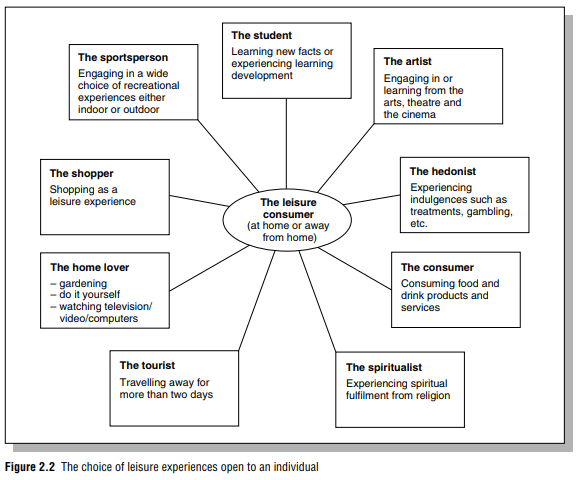
[Leisure Marketing – a global perspective by Susan Horner & John Swarbrooke, Figure 2.2, pg23]
Going further about why people travel and whatnot, leisure and stuff. There’s a lot to explain really because people have a wide range of reasons for why they want to go out and see the world, or for whatever reason. Travelling specifically is one of the few leisure activities that intertwine with other leisure activities as all of those such things are also present in travelling. You may use your imagination as to why you would want to go for a trip, and compare it to why your friend, family, teacher, boss or any other person would go for a trip. Everyone has different reasons, but all of them lead to the need for leisure, and as a result, a consumption of leisure facilities and services.

 Sometotallyunnecessarilylongnameforablog